
Perfectionism and Impostor Syndrome: Understand the Inner Critic and How Therapy Can Help
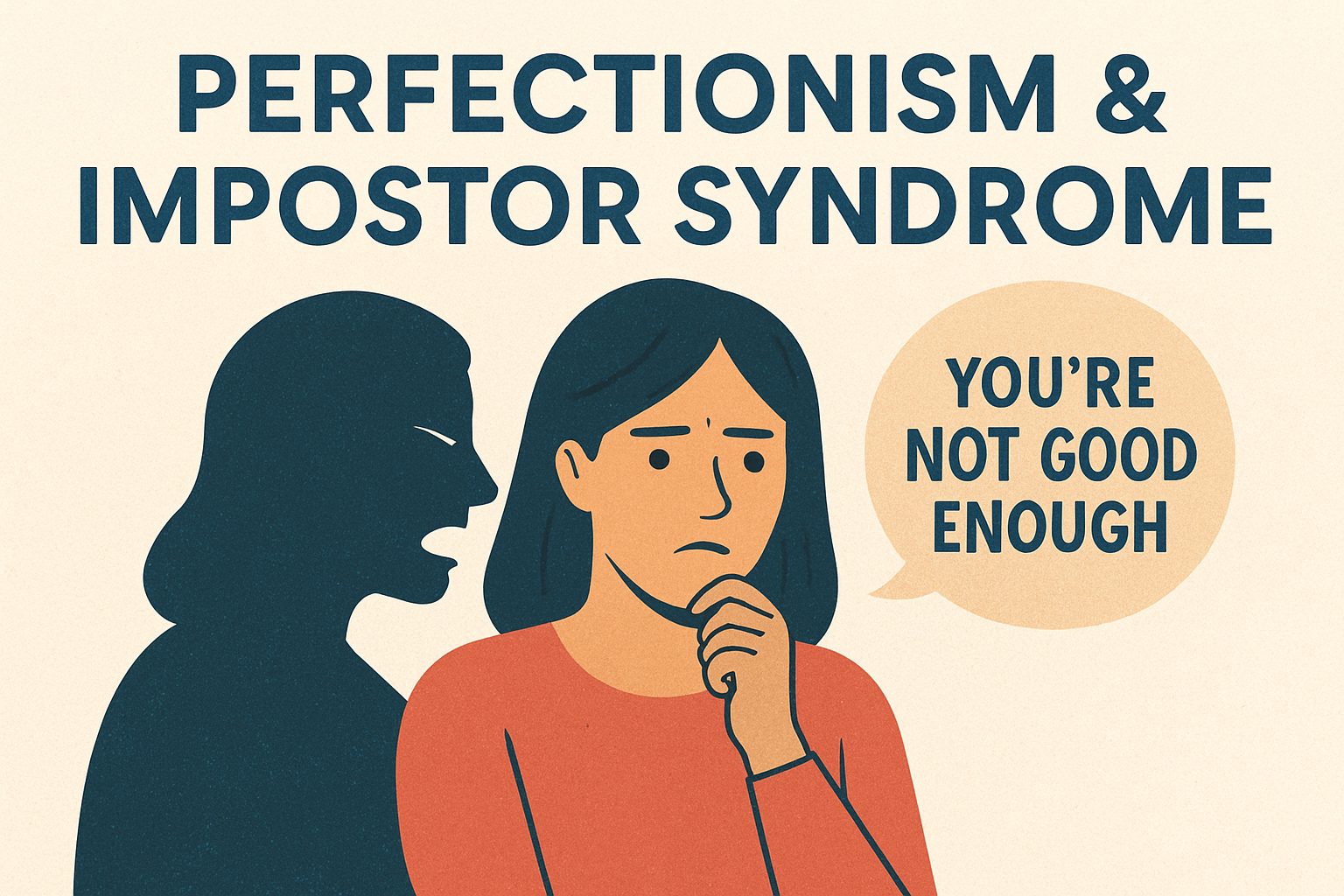
If you’re reading this, you’ve likely heard your inner critic whisper scathing words like, “You’re not good enough,” even when you’ve accomplished something meaningful. You’re dedicated, and it matters deeply to you that your work reflects your effort, intelligence, and values. Wanting to be seen as capable and competent is human—and you’re not alone.
Fear of failure, feelings of unworthiness, or the worry of being “found out” as a fraud can be overwhelming. These experiences are often driven by perfectionism and impostor syndrome—two closely connected patterns that can leave you feeling like you’re never quite good enough, no matter how hard you try.
Understanding perfectionism and impostor syndrome—and how they show up in your life—is the first step toward healing. Below, we explore how these patterns are similar, how they differ, and how therapy can help you reconnect with your authentic self.
What Are Perfectionism and Impostor Syndrome?
Perfectionism
Perfectionism is more than striving for excellence or setting high standards. While it can motivate achievement, it often creates chronic pressure, fuels avoidance of failure or rejection, and ties self-worth to performance.
You might feel like your value must be earned through success—and that mistakes are unacceptable or devastating.
Perfectionism can look like:
Procrastinating because you don’t want to start imperfectly
Overworking, over-editing, or avoiding feedback
Feeling anxious when things are “good enough” but not ideal
Setting unrealistic or unattainable standards
Perfectionism is typically driven by fear—fear of failure, rejection, or being seen as inadequate. These behaviors often develop as attempts to stay safe and in control. But acceptance does not require perfection.
Impostor Syndrome
Have you ever felt like a fraud despite clear evidence of your competence? Or worried that others will eventually realize you’re not as capable as they think you are?
This experience is known as impostor syndrome—the belief that your success is undeserved and that exposure is inevitable.
Impostor syndrome can look like:
Downplaying your accomplishments or attributing success to luck
Feeling uncomfortable receiving praise or recognition
Constantly comparing yourself to others
Persistent feelings of being a fraud
With impostor syndrome, you may minimize your own effort, even though it’s likely the reason you’ve succeeded. The inner voice saying “I don’t belong here” often grows louder when you step into new roles or challenges.
Are Perfectionism and Impostor Syndrome the Same?
Perfectionism and impostor syndrome overlap, but they are not the same. Both are rooted in insecurity, self-doubt, and fear, and both can contribute to anxiety, depression, and burnout.
Think of it this way:
Perfectionism says, “I must be flawless to be accepted.”
Impostor syndrome says, “I’m not really who they think I am.”
Perfectionism focuses on avoiding mistakes and constantly doing better. Impostor syndrome focuses on feeling undeserving and fearing exposure. Together, they can create a relentless internal pressure that no achievement seems to relieve.
Where Do Perfectionism and Impostor Syndrome Come From?
These patterns often develop from early relational experiences. If love, attention, or approval were tied to achievement, you may have learned that your worth depends on performance. If caregivers were critical, emotionally unavailable, or inconsistent, you may have internalized the belief that connection must be earned.
Over time, these beliefs can become ingrained and feel like part of your identity, leading to behaviors rooted in fear and emotional self-protection.
Perfectionism and impostor syndrome don’t only show up at work. They can affect many areas of life:
At work: Over-functioning, avoiding delegation, fear of being “found out”
At school: Comparison, fear of asking for help, chronic self-doubt
At home: Difficulty resting, guilt around downtime, feeling like you’re not enough
In relationships: People-pleasing, fear of rejection, discomfort receiving praise
These patterns can deeply impact self-worth, making it feel conditional on performance and leading you to dismiss your own accomplishments.
Not sure whether you’re experiencing perfectionism, impostor syndrome, or both? Therapy can help you uncover where these patterns began, how they affect you now, and how to build greater self-trust.
How Therapy Can Help Heal Perfectionism and Impostor Syndrome
Healing isn’t about fixing something that’s “wrong” with you. It’s about reconnecting with the parts of yourself that learned to survive through overachievement, self-criticism, or control.
At our practice, therapy is grounded in compassion and evidence-based approaches tailored to your needs.
Attachment & Psychodynamic Therapy
Work with Dr. Wainer, clinical psychologist, to explore how early relationships shaped your beliefs about worth, safety, and love. You’ll identify internalized narratives—such as believing you’re only valuable when you succeed—and begin to challenge them. Through a secure therapeutic relationship, new emotional experiences can foster a more compassionate inner world.
Interpersonal Therapy (IPT)
IPT focuses on relationships and social roles. A therapist can help you examine how self-perception is influenced by expectations, comparison, and fear of judgment, while building skills to communicate needs and reduce self-doubt.
Emotion-Focused Therapy (EFT)
EFT helps you access and process the emotions beneath perfectionism and shame. With guidance, you’ll learn to differentiate between primary emotions (like fear or sadness) and secondary reactions (like anxiety or anger), allowing self-compassion to replace self-criticism.
Cognitive Behavioral Therapy (CBT)
CBT helps identify and challenge unhelpful thought patterns. You’ll learn to test beliefs like “I’ll be rejected if I don’t do this perfectly” and replace them with more balanced, realistic thoughts such as “I am doing my best, and that is enough.”
A Mindfulness-Based Approach
Mindfulness supports present-moment awareness and interrupts cycles of self-judgment. In therapy, you’ll learn to observe thoughts and emotions without reacting to them, cultivating greater calm, clarity, and acceptance.
Stepping Out of the Shadows of Perfectionism and Impostor Syndrome
You don’t have to keep living under the weight of perfectionism or impostor syndrome. Dr. Wainer offers psychotherapy in a safe, supportive space where you can explore these patterns, reconnect with your authentic self, and build a life rooted in self-trust rather than self-doubt.
You’re not a fraud. You’re not failing. You’re a human being who learned ways to stay safe—and you’re allowed to unlearn what no longer serves you.
If you’re ready to begin your healing journey, consider reaching out to work with one of our providers today.
Sources
Azab, M. (2023, August, 29). Overcoming Impostor Syndrome: 6 Evidence-Based Strategies. Psychology Today.
Cokley, K., Stone, S., Krueger, N., Bailey, M., Garba, R., & Hurst, A. (2018). Self-esteem as a mediator of the link between perfectionism and the impostor phenomenon. Personality and Individual Differences, 135, 292-297. https://www.sciencedirect.com/science/article/abs/pii/S0191886918304276
Dudău, D. P. (2014). The relation between perfectionism and impostor phenomenon. Procedia-Social and Behavioral Sciences, 127, 129-133. https://www.sciencedirect.com/science/article/pii/S1877042814023179
Gardenswartz, C. (2024, August 5). Overcoming Perfectionism. Psychology Today. https://www.psychologytoday.com/us/blog/the-discomfort-zone/202408/overcoming-perfectionism
Price, M. (2021, November 28). Escaping the prison of perfectionism and imposter syndrome. Psychology Today.